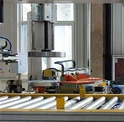
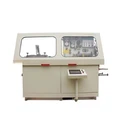
The width of the planed veneer is narrow, usually 300mm for occasions with special requirements.
1. Low speed and large torque. Compared with electromagnetic motors, the most significant feature of ultrasonic motors is their high torque output at low speeds. The torque density (torque to weight ratio) of the ultrasonic motor is more than 100 to 1000 times that of the electromagnetic motor.
2. The structure is simple and flexible, and the movement forms are diverse. Ultrasonic motors are generally composed of a stator and a rotor (or moving body), and the stator and rotor of the motor can be easily integrated with the fixed parts and moving parts of the motion system respectively. Ultrasonic motors have a variety of flexible structural forms such as rings, circular plates, square plates, cylinders and spheres, and are very easy to realize various forms of motion, such as rotational motion, linear motion, two-dimensional plane motion and three-dimensional motion.
3. Life, noise and reliability issues. Since most of the driving of ultrasonic motors is contact type, this will inevitably bring about the problem of friction loss between the stator and the rotor.
At present, the continuous working life of the developed low-power ultrasonic motors is generally about several thousand hours. Ultrasonic motors have short lifespan, poor reliability, and unstable operation, which are urgent problems that restrict their practicality and industrialization and need to be solved. However, in some situations with special working properties or special requirements for the motor, ultrasonic motors can still give full play to their advantages of large torque density, flexible structure, no electromagnetic interference, and large static holding torque. Ultrasonic motors are widely used in aerospace, finishing equipment, automotive industry, scientific instruments or medical equipment with strong magnetic fields or requirements for magnetic fields, precision instrumentation, office automation equipment, micromachines, military industry and semiconductor processing industry and other related fields. . Left and right or narrower, all need to be spliced, the wood utilization rate is low, and the productivity of planing is only about 10% of that of rotary cutting; the currently used planing machines only cut thin wood.
Jul 11, 2024
Disadvantages Of Peeling Machine
Send Inquiry
Product Categories