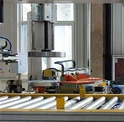
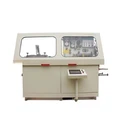
Wood slicers are the main equipment for producing veneers and thin wood. According to the direction of the planer's movement relative to the horizontal plane, wood slicers can be divided into two categories: vertical and horizontal; according to whether the planing direction is perpendicular or parallel to the length of the wood fiber, the slicer can be divided into transverse slicers and longitudinal slicers. The size of modern slicers is only 1/3 of that of the past slicers, with a compact structure, light weight, and easy installation and commissioning; it can produce continuously, save time for loading wood, and has high production efficiency; it works very smoothly and almost no noise is heard.
Peelers are also one of the main equipment for producing veneers. In a sense, they are more widely used than slicers. Peelers can be divided into concentric peeling and eccentric peeling according to whether the wood section rotates around its own axis. Concentric peelers are divided into two types: shaft peelers and shaftless peelers. Eccentric peeling can obtain beautiful radial patterns, but the productivity is lower than concentric peeling.
Peeling machines are usually large and complex in structure. The logs need to be centered before being put on the machine. If the centering is not accurate, discontinuous veneer strips or narrow veneers will be spun out when peeling begins. The more broken veneers or narrow veneers there are, the more good sapwood veneers will be lost, which is not conducive to continuous production. Logs with bends, irregular cross-sections, and large and small ends (taper) at both ends are likely to cause the veneers that are spun out to be broken veneers, wasting wood. And when the log diameter is reduced to a certain extent, it can no longer be peeled (that is, the remaining wood core causes wood waste).
Jul 12, 2024
Difference Between Rotary Cutting Machines
Send Inquiry
Product Categories